Why more and more Health care staff are infected by Ebola virus?
Word Health Organization (WHO) reports more than 100 health-care workers have been exposed to the virus while caring for Ebola patients. (1) The report continues by assuming that “this happens because they may not have been wearing personal protection equipment or were not properly applying infection prevention and control measures when caring for the patients.” The report later concludes that Health-care providers at all levels of the health system – hospitals, clinics, and health posts – should be briefed on the nature of the disease and how it is transmitted, and strictly follow recommended infection control precautions.
Well, such underestimation of the health care staff’s awareness and adherence to Ebola prevention measures is strange! As a physician I would do nothing but overprotecting myself if I were in an epidemic zone of the most fatal viral disease. I am sure other healthcare providers will do and are doing the same. One may only fall short of using personal protection equipment (PPE) if it becomes impossible to bear as a result of excessive heat or fatigue.
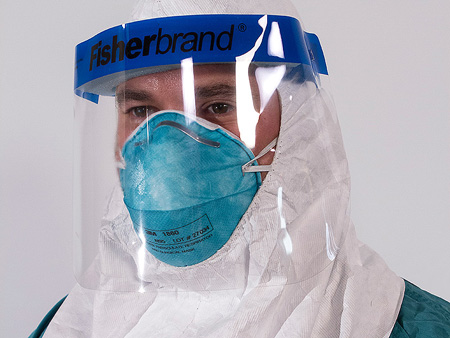
Current CDC guidelines for Ebola prevention recommendations entail a combination of strict droplet, contact and airborne precautions. As the first step, CDC recommends avoiding contact with Ebola patients and their body fluids as much as possible! (2) As the second step, it recommends the use of PPE in contact with Ebola patients. The recommended PPE includes water proof surgical gown and hat, mask and respirator, boots, goggles or face shield and double gloves. At the same time, CDC itself acknowledges the hardship of tolerating such outfit in poorly air conditioned hospital buildings in the warm climate of Sierra Leone and Guinea. On the CDC Ebola web page, PPE instructions are followed by a series of recommendation for prevention of heat stroke!…. CDC recommends that health care staff drink ample amounts of fluids and oral rehydration solutions, periodically check their body temperatures and take frequent breaks. They can return to hospital wards when their body temperature falls under 38 C or 100.4 F! Please pay attention: the threshold for normal body temperature is set at 100.4 F! (2)
In another section, CDC recommends “limiting the number of healthcare workers who come into contact with the Ebola patient (e.g., avoid short shifts), and restrict non-essential personnel and visitors from the patient care area.” (3) Now the next question is how healthcare staff can take periodic oral temperatures and frequent breaks during their long shifts in the areas of such nursing shortage?
Putting myself in the shoes of the health staff working in Ebola region, especially the ones who have traveled from North America or Europe and are not acclimatized to West African warm climate, I can totally understand how some may fail to fully comply with the recommended PPE at times. It is also important to bear in mind that increased fatigue increases the chance of contracting any disease, especially a disease as highly virulent as Ebola.
References:
1- http://www.who.int/csr/disease/ebola/faq-ebola/en/
2- http://www.cdc.gov/vhf/ebola/hcp/limiting-heat-burden.html
3- http://www.cdc.gov/vhf/ebola/hcp/procedures-for-ppe.html
Image courtesy of Medscape.com
About Post Author